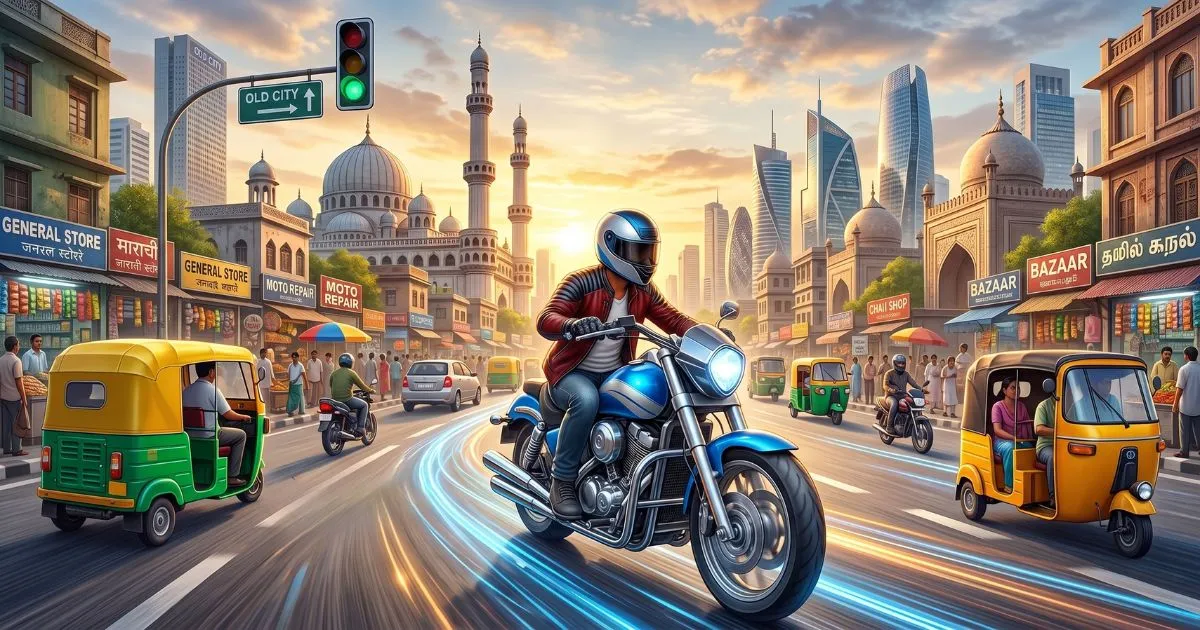
You have completed the early missions. You understand how braking works. You have tried several feature codes and found your preferred bike. Now what? This guide covers the techniques that separate competent players from efficient ones — the habits, decisions, and awareness that cut time off missions, reduce retries, and make free roam exploration more rewarding. These are practical techniques developed through extended play, not shortcuts or exploits. If you are new to the game, start with our beginner guide first and return here once the basics feel comfortable.
Traffic reading at an advanced level
Beginner players react to traffic. Advanced players read it two or three moves ahead. The distinction is everything in timed missions. As you approach an intersection, your focus should not be on the vehicle immediately in front of you — it should be on the vehicles two or three positions ahead and the gaps that are opening or closing based on their movement.
Develop the habit of scanning left and right through intersections before you arrive. If you see a gap opening on the left two seconds before you reach the junction, you can set up your approach early rather than reacting to it at the last moment. Reactive driving means you are always arriving slightly behind the gap. Anticipatory driving means you arrive exactly when the gap is widest.
NPC vehicle patterns in Indian Bike Driving 3D are not entirely random. Observe the same intersection through two or three retries and you will notice that lane changes and stopping behaviour follow repeatable rhythms. Use this. The third retry on a mission should feel noticeably smoother than the first because you are using remembered traffic patterns rather than reacting fresh.
Camera management as a skill
The default camera handles most situations, but expert players switch camera angle strategically. A wider camera view gives you more peripheral vision for cross traffic at intersections — switch to it before entering complex junction areas. A closer follow camera gives better depth perception for tight overtakes between vehicles on straight roads.
The critical rule is never switch camera during a manoeuvre. Switch during straight sections where you have a moment of predictable space. Switching mid-corner or mid-overtake stacks two risks at once — the manoeuvre itself and the visual adjustment. Practice camera switches in free roam until the input is automatic, so in missions it costs no conscious attention.
Braking technique — beyond the basics
The beginner tip is to brake earlier than your instincts suggest. The advanced technique is to modulate braking pressure rather than applying it in a single on-off action. Trail braking — maintaining light brake pressure into the early part of a corner before releasing — keeps the bike more settled through the turn than full release before the apex. On phone controls this is harder to execute than in a simulator, but partial brake application (not full pressure) during corner entry will produce noticeably cleaner exits compared to all-or-nothing inputs.
Also pay attention to the road surface. Some sections in Indian Bike Driving 3D have surface variation that affects how the bike holds through braking. Braking on a road camber that runs against your direction of travel requires more distance. Recognise these sections on routes you repeat.
Mission efficiency — reducing total time, not just lap time
Players often focus on the in-mission time — how fast they complete the route. But total session efficiency includes everything outside the mission timer: how quickly you restart after a failure, how long you spend in menus, and how many exploratory runs you do before committing to a full attempt.
Advanced players minimise pre-mission exploration by making decisions faster. If you have done one slow look at a route, commit to a full attempt. The information from an actual timed run tells you far more than a third exploratory lap. Be willing to accept one or two crash failures as the actual learning, rather than treating every run as high-stakes.
After a failure, identify the specific moment where the run became unrecoverable. Not the crash — the decision before the crash that made it inevitable. That is your actual correction target. Changing your bike speed or approach to the corner just before the crash point is more efficient than trying to change everything about the run.
Settings optimisation for your device
Performance settings significantly affect control feel, especially on older devices. If your device struggles with the highest graphics settings, the frame rate drops will introduce input lag that makes steering feel unreliable. This is not a skill problem — it is a hardware problem that a settings change can fix.
Reduce graphics quality until the game runs smoothly and frame pacing feels consistent. The visual difference between high and medium settings is far less noticeable than the difference between smooth input response and occasional stutters. Competitive mission performance requires predictable input response above all else.
Control sensitivity is equally important. Tilt control players should experiment with sensitivity calibration regularly — your grip position changes between sessions, which affects how the tilting translates to steering input. If steering feels inconsistent, recalibrate before blaming your technique.
Using feature codes as session tools
Advanced players use feature codes strategically rather than just for novelty. Infinity Health (code: 9129) is genuinely useful for learning new mission routes — activating it removes one variable so you can focus purely on route and timing. More Traffic (code: 54321) functions as a difficulty increase for players who have mastered normal conditions. Night Mode (code: 9) changes the visual feedback of city navigation enough that it develops different awareness skills compared to daytime play.
Think of the effects codes as session modes rather than cheats. Each one changes what you are practising. See our feature codes page for the full list.
Map knowledge — the compounding advantage
Map knowledge is the skill in Indian Bike Driving 3D that compounds most strongly over time. Every section of city you understand well — its junction timing, its traffic density patterns, its shortcut opportunities — pays dividends on every future mission that touches that section. Players who have spent significant time in free roam before attacking missions will clear the same routes faster than players who go straight to mission grinding.
If a mission route passes through an area you do not know well, do one or two free roam runs specifically through that section outside of mission pressure. Understand where the road widens, where NPC vehicles tend to cluster, and where your best overtaking opportunities are. Then bring that knowledge into the mission.
Managing long sessions
Steering performance on mobile genuinely degrades over long sessions due to hand fatigue, reduced grip from sweat, and declining concentration. Take breaks after fifteen to twenty minutes of intensive mission play. The retry that feels impossible at minute forty of a session will often feel straightforward after a five-minute break. This is not a motivation problem — it is physiology. Build session management into your play the same way you build braking points and traffic reads.
Frequently Asked Questions
At what point should I consider myself an advanced player?
When you stop reacting to individual traffic events and start reading the full intersection ahead of time. That shift in awareness is the marker of advanced play in Indian Bike Driving 3D.
Should I always use the fastest bike for missions?
No. The fastest bike suits open routes. Technical city missions often benefit from a more agile, lower-speed bike like the KTM RC or Yamaha R15. Choose vehicle based on route type, not habit.
How do I improve at landings from Super Jump?
Practice in free roam with Infinity Health active. Identify where the bike points during the airborne phase and steer to correct it before landing. Landing skill in high-jump situations is primarily about reading descent angle rather than lastsecond correction.
Does device brand matter for game performance?
Device performance (RAM, processor) matters more than brand. Reduce graphics settings on lower-specification devices and prioritise smooth frame rate over visual quality for consistent mission performance.
Conclusion
Advanced play in Indian Bike Driving 3D is about awareness, consistency, and efficiency rather than any single trick or exploit. Read traffic ahead, manage your camera deliberately, brake with modulation rather than on-off pressure, use your session time efficiently, and maintain your map knowledge. These habits compound over time — each session adds to a foundation that makes every future mission feel slightly more within your control. For route-specific strategy, visit our mission tips guide and timed missions guide. For vehicle selection based on your play style, see our full guides section.